

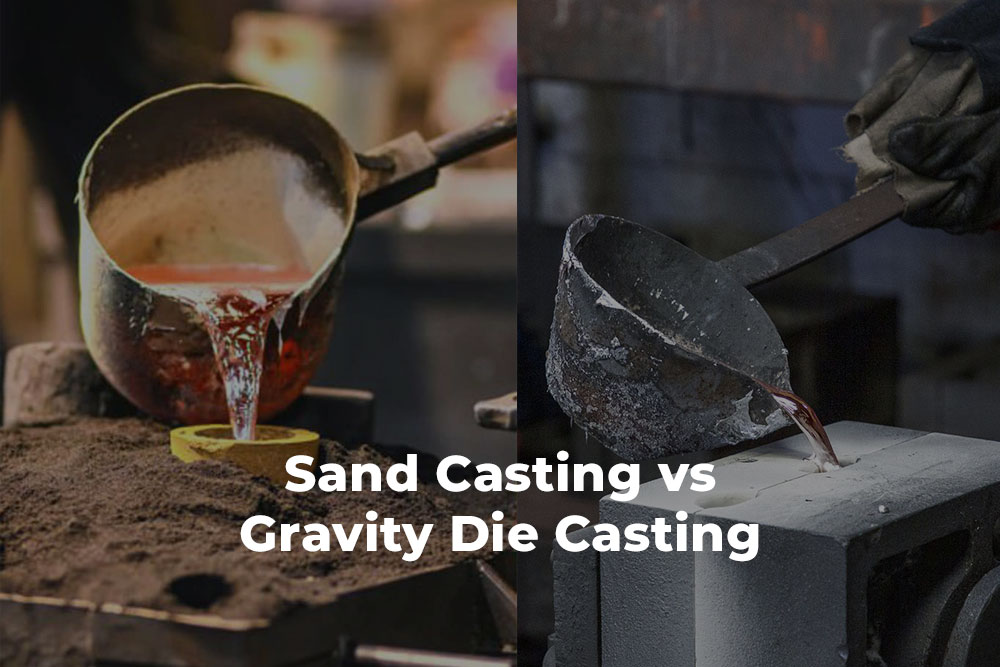
Sand Casting vs Gravity Die Casting: Which Is Right for Your Project?
Choosing the right casting process is one of the most important decisions in any manufacturing project. The method you select directly affects component quality, cost, lead time, and long-term performance.
Two of the most widely used processes in aluminium manufacturing are sand casting and gravity die casting. While both offer distinct advantages, each is suited to different applications, volumes, and design requirements.
In this article, we compare sand casting vs gravity die casting to help you determine which process is right for your project — and when working with an experienced UK foundry can make all the difference.
Looking for a UK aluminium casting manufacturer?
We provide aluminium castings throughout the West Midlands and United Kingdom.
Learn more about our Aluminium Casting services.
What Is Sand Casting?
Sand casting is one of the oldest and most versatile metal casting processes. It involves creating a mould from sand, into which molten aluminium is poured. Once the metal solidifies, the sand mould is broken away to reveal the casting.
Key Characteristics of Sand Casting
- Highly flexible process
- Suitable for complex geometries
- Ideal for low to medium production volumes
- Lower tooling costs
- Longer cycle times
Sand casting remains popular for custom parts, prototyping, and components with complex internal features.
What Is Gravity Die Casting?
Gravity die casting (also known as permanent mould casting) uses a reusable metal mould, typically made from steel or cast iron. Molten aluminium is poured into the die using gravity rather than pressure.
Key Characteristics of Gravity Die Casting
- Excellent surface finish
- Higher dimensional accuracy
- Consistent mechanical properties
- Faster cycle times for production runs
- Higher tooling costs
This process is ideal for repeatable, higher-volume production where consistency and quality are critical.
Sand Casting vs Gravity Die Casting: Key Differences
1. Tooling Cost
Sand Casting
- Low initial tooling cost
- Suitable for one-off parts or small batches
- Ideal for prototyping
Gravity Die Casting
- Higher upfront tooling cost
- Tooling lasts for thousands of castings
- Cost-effective at higher volumes
Best choice:
Low volume → Sand casting
Medium to high volume → Gravity die casting
2. Surface Finish and Accuracy
Sand Casting
- Rougher surface finish
- Wider tolerances
- More post-machining is often required
Gravity Die Casting
- Smooth surface finish
- Tighter tolerances
- Reduced machining requirements
Best choice:
High cosmetic or tolerance requirements → Gravity die casting
3. Mechanical Properties
Sand Casting
- Slower cooling results in a coarser grain structure
- Slightly lower mechanical strength
Gravity Die Casting
- Faster cooling improves grain refinement
- Higher strength and consistency
Best choice:
Load-bearing or structural components → Gravity die casting
4. Design Flexibility
Sand Casting
- Excellent for complex shapes
- Easier to incorporate cores and internal passages
- Ideal for intricate designs
Gravity Die Casting
- More design constraints due to the rigid mould
- Cores are possible, but more limited
Best choice:
Highly complex geometries → Sand casting
5. Production Volume and Lead Time
Sand Casting
- Slower per-part production
- Shorter tooling lead time
- Ideal for small batch runs
Gravity Die Casting
- Faster cycle times
- Longer tooling development phase
- Excellent repeatability
Best choice:
Short runs or urgent projects → Sand casting
Repeat production → Gravity die casting
Sand Casting vs Gravity Die Casting: At a Glance
| Tooling cost | Low | High |
| Surface finish | Rough | Smooth |
| Tolerances | Moderate | Tight |
| Mechanical strength | Medium | High |
| Design flexibility | Very high | Medium |
| Ideal volume | Low–medium | Medium–high |
| Lead time | Short tooling | Longer tooling |
| Repeatability | Moderate | Excellent |
Which Process Is Right for Your Project?
Choosing between sand casting and gravity die casting depends on several key factors:
Sand Casting Is Best When:
- Production volumes are low
- The tooling budget is limited
- The design is complex
- Prototyping or one-off components are required
Gravity Die Casting Is Best When:
- Production volumes justify tooling investment
- Surface finish and dimensional accuracy are critical
- Strength and repeatability are required
- Machining time needs to be minimised
How a UK Foundry Can Help You Decide
An experienced UK foundry does more than simply produce castings — it helps guide the process selection based on performance, cost, and long-term requirements.
At DAC Industries, we:
- Review designs for manufacturability
- Recommend the most cost-effective casting method
- Advice on alloy selection
- Optimise tooling and machining strategies
- Support customers from concept to finished component
Early engagement often reveals opportunities to reduce cost, improve quality, and shorten lead times.
Conclusion
Both sand casting and gravity die casting have their place in modern aluminium manufacturing. The right choice depends on your design, volume, quality requirements, and budget.
By working closely with a knowledgeable UK foundry and selecting the appropriate casting process early, you can avoid unnecessary costs and achieve consistent, high-quality results.
If you’re unsure which process is right for your next project, expert guidance at the design stage can make all the difference.



Leave a Reply